Skunk Trapping and Removal
Skunk Trapping and Removal Services in Seacoast New Hampshire & Maine, NH Lakes Region, and Neighboring Towns
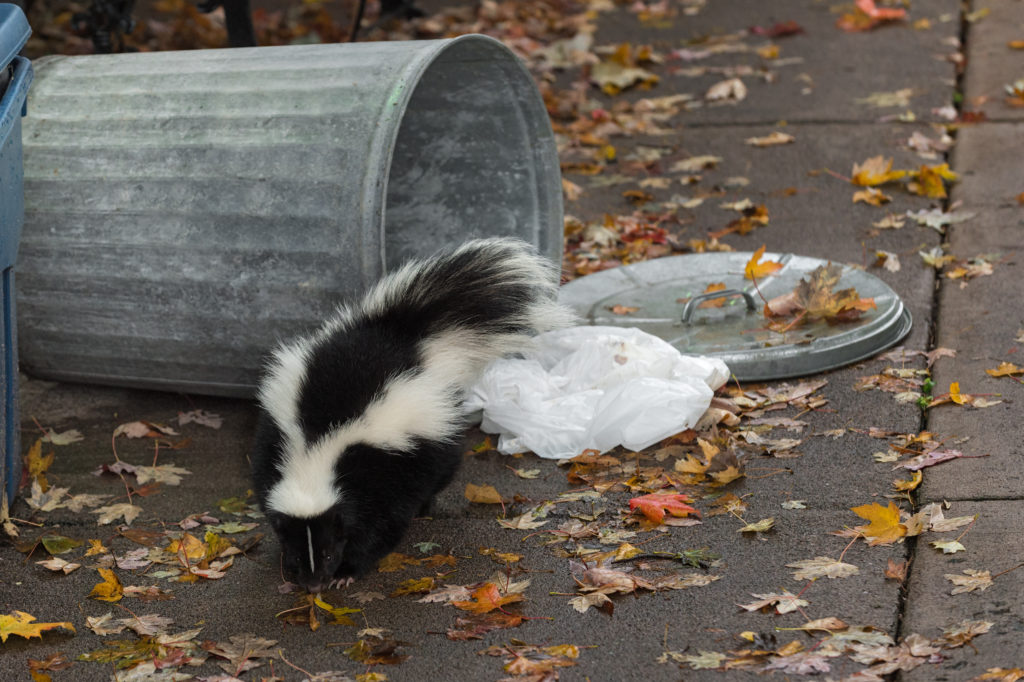
Did you know skunks are one of the most common nuisance wildlife animals for homeowners and businesses? They’re notorious for their acrid, unmistakable scent, produced by a pair of scent glands that can be detected from a great distance.
The Advanced Wildlife Control team are experts at humanely and safely removing skunks, offering 24-hour emergency skunk trapping and removal solutions for your residence or business.
Estimates are always free and are provided with both emergency and long-term solutions to remove skunks safely and relocate them to a more suitable environment.
If you’re concerned about a skunk problem, contact us for skunk removal services today. Call or text now — our estimates are always FREE.
Skunk Safety in NH and Maine
Skunks are one of four animals — along with foxes, raccoons, and bats — considered primary carriers of the rabies virus and classified as rabies vector species. Skunks have also been known to carry leptospirosis, a bacterial disease that affects both humans and animals.
- Rabies — the most common disease associated with skunks. It is transmitted by bite and can be passed to animals and people. Rabies can make victims very sick and, if left untreated, is fatal.
- Leptospirosis — a bacterial disease caused by bacteria of the genus Leptospira. In humans, it can cause a wide range of symptoms, some of which may be mistaken for other illnesses. In some cases, infected individuals may have no symptoms at all.
Beyond the risk of being sprayed with their unmistakable pungent odor, the potential health hazards associated with skunks mean property owners and property managers are strongly advised not to attempt skunk removal on their own.
Contact our experts who know how to safely and humanely remove and relocate these animals.
Servicing New Hampshire & Maine
- 1-603-833-2444
- Certified and Fully Insured
- Locally Owned and Operated for over 4-decades
Skunk Prevention
Preventing skunks from returning is just as important as removing them. Our skunk prevention services focus on identifying and eliminating attractants, sealing off denning areas, and installing proven exclusion solutions around decks, sheds, porches, and foundations. By addressing food sources, entry points, and habitat conditions, we help protect your property from future skunk activity and long-term nuisance issues.
Skunk Removal FAQs
1. Why do skunks spray, and how far can they spray?
Skunks spray as a defense mechanism when they feel threatened. Their spray can reach distances of up to 10–15 feet, and the odor can linger for days (or longer) if it isn’t treated properly.
2. What attracts skunks to my property?
Skunks are attracted to easy food sources like outdoor pet food, unsecured trash, bird seed, compost piles, fallen fruit, and grubs in the lawn. They also look for sheltered denning areas under decks, sheds, porches, and foundations.
3. Are skunks dangerous to humans or pets?
Skunks are usually not aggressive, but they can carry rabies and other diseases. Pets are at higher risk because they may try to chase or corner a skunk, which can result in spraying or a bite.
4. How can I tell if a skunk is living under my deck or shed?
Common signs include a persistent skunk odor, small cone-shaped holes in the lawn (digging for grubs), tracks or a worn path along a structure, and a visible opening where soil has been dug out near a foundation or under a deck.
5. What should I do if I see a skunk during the day?
Seeing a skunk in daylight doesn’t automatically mean it’s rabid—skunks may be active during the day when food is scarce or when a mother is caring for young. However, if the skunk appears disoriented, unusually aggressive, or stumbling, keep your distance and call a professional.